

Learn how virtual international phone numbers work, how incoming calls are routed, where calls can be answered, and how businesses can establish a local phone presence without a traditional office.
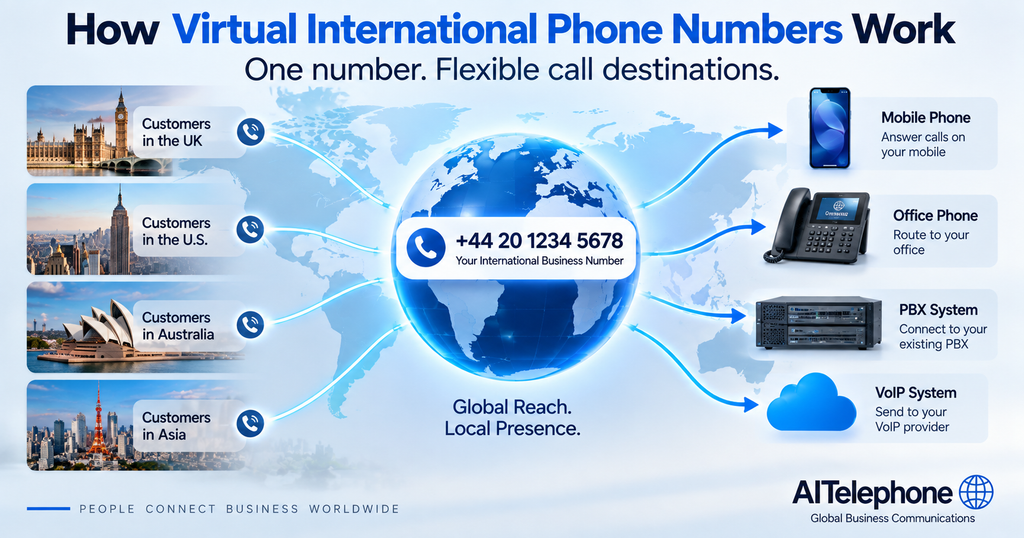
Virtual International Phone Numbers Work for your company globally.
A business can have customers in another country without having its telephone system physically located there.
That is the basic idea behind a virtual international phone number.
Instead of being permanently tied to a particular physical telephone line or office, a virtual number can be configured to route incoming calls to a destination chosen by the customer. That destination might be a mobile phone, landline, PBX, or VoIP system.
For example, a business headquartered in the United States could obtain a phone number associated with another country and have incoming calls routed to its existing U.S. office.
The caller reaches the international number. The business receives the call wherever it has configured the call to go.
AITelephone currently offers local and toll-free virtual phone numbers in more than 160 countries, with specific number types and availability varying by country and location.
What are Virtual International Phone Numbers?
A virtual international phone number is a telephone number associated with a particular country, city, or geographic market that is not necessarily tied to the physical location where the call is answered.
A traditional business telephone number may be directly associated with an office telephone system.
A virtual number separates those two functions:
The number provides the telephone identity.
The forwarding or routing system determines where the call is delivered.
This separation gives businesses considerably more flexibility when serving customers in multiple countries.
A company can establish a telephone presence in one market while its employees, offices, or call-handling systems are somewhere else.
How Virtual International Phone Numbers Work?
The process can be understood in four basic steps.
1. Choose the Country or Market
The business first chooses the country where it wants a telephone presence.
Depending on the country and available inventory, the business may be able to select a local or toll-free number.
The exact number types, locations, and requirements vary by country, so availability should always be checked for the specific market.
AITelephone currently states that local and toll-free virtual numbers are available in more than 160 countries.
Need a Phone Number in Another Country?
2. Obtain the Virtual Number
The selected number is assigned to the customer’s account.
The number is dedicated to that account, allowing callers to dial it directly without needing an extension or access code.
At this point, the number can serve as a public telephone contact for the business.
3. Select Where Calls Should Go
The business designates the destination where incoming calls should be delivered.
AITelephone supports forwarding to destinations including:
- Mobile phones
- Landlines
- PBX systems
- VoIP destinations
The destination can be in a different country from the virtual phone number.
For example:
Customer in London → London virtual number → U.S. business office
The customer calls the London number, while the business can answer the call in its existing U.S. operation.
4. Manage the Number Online
After activation, customers can manage supported features and call-routing settings through their online account portal.
AITelephone states that forwarding destinations can be changed through the portal, with changes taking effect in real time.
This means the business does not necessarily have to change the published telephone number when its employees, offices, or operating arrangements change.
A Simple Example
Imagine a company based in California that begins serving customers in Australia.
The company wants Australian customers to have a convenient Australian telephone number rather than requiring them to call a U.S. number.
The company could investigate an Australian virtual number.
The resulting call flow might look like this:
Australian customer
↓
Australian virtual business number
↓
International call-routing service
↓
California office, mobile phone, PBX, or VoIP system
The customer does not need to know where the company’s employees are located.
From the customer’s perspective, the important thing is having a telephone number appropriate to the market being served.
Do virtual international phone numbers Ring a Physical Phone?
It can.
A virtual number itself is not necessarily the physical device that rings.
Instead, incoming calls can be routed to a destination selected by the customer.
For example, AITelephone supports forwarding to:
- An existing mobile phone
- A traditional landline
- A PBX
- A VoIP system
This is one of the main differences between a virtual number and a conventional telephone installation.
The business can keep its existing communications equipment while adding another public telephone number.
Can the Number Be Used With an Existing Phone System?
Yes.
A business does not necessarily need to replace its current phone system simply because it wants an international telephone presence.
AITelephone’s current service information specifically describes integration with existing phones, PBX systems, and VoIP destinations.
This can be particularly useful for a company that already has an established communications system.
Instead of creating a completely separate telephone operation in every country, the company can add virtual numbers and route calls back to its existing infrastructure.
What Happens When Someone Calls the Number?
The process is largely invisible to the caller.
A customer dials the virtual international number.
The telephone network delivers the call to the virtual number.
The service then routes the incoming call according to the business’s configuration.
The call can be delivered to the designated phone or communications system.
For example:
Caller → Virtual Number → Forwarding → Mobile Phone
Or:
Caller → Virtual Number → Forwarding → PBX
Or:
Caller → Virtual Number → Forwarding → VoIP System
The virtual number therefore acts as the public entry point, while the destination can remain separate.
Can One Virtual Number Ring Multiple Phones?
AITelephone supports simultaneous ringing for incoming calls, allowing calls to ring multiple phones at the same time where supported.
This can be useful when several people need the opportunity to answer the same business number.
For example, a business could configure an incoming number to ring an office phone and one or more mobile destinations simultaneously.
The objective is simple: reduce the chance that an important business call goes unanswered.
Can Calls Be Routed According to the Time of Day?
Yes.
AITelephone supports time-of-day routing with time-zone settings.
This can be particularly useful for international businesses because customers may call from several time zones.
For example, a business could configure calls to go to one destination during its normal business hours and another destination after hours.
A possible arrangement might be:
Business hours → Main office
After hours → Remote employee or alternate destination
The specific routing configuration depends on the features available for the selected service.
Can the Forwarding Destination Be Changed?
Yes.
The forwarding destination can be changed through the online account portal, according to AITelephone’s current service information.
This provides flexibility when a business changes how it handles calls.
For example, a company might initially route calls to an employee’s mobile phone while testing a new market.
Later, it could route the same number to a business PBX or VoIP system.
The published telephone number can remain the same while the call destination changes.
Can an International Virtual Number Be Used for Outbound Calls?
Sometimes.
Receiving calls and making outbound calls are not necessarily the same capability.
AITelephone offers a Geographic Local 2-Way Voice option in supported countries. When available, it allows outbound calls using the virtual number as the caller ID. AITelephone currently describes this option as available in approximately 70 countries, rather than across its entire international coverage.
Therefore, a business that needs two-way calling should specifically check whether the option is available for the country and number it wants.
Do not assume that every virtual international number automatically provides identical outbound functionality.
What Features Can Be Available With a Virtual Number?
A virtual international number can provide more than simple call forwarding.
AITelephone’s current service information includes features such as:
- Call forwarding
- Voicemail
- Voicemail-to-email
- Time-of-day routing
- Extension call routing
- Simultaneous ringing
- Call recording
- Caller ID
- Call activity information
- Local 2-Way Voice in supported countries
- SMS functionality for supported numbers
The exact features available can depend on the number and service selected.
This is another reason to evaluate the specific number configuration rather than assuming every country and number type offers exactly the same features.
Does a Virtual Number Require a Physical Office?
Not necessarily.
AITelephone states that in many countries a physical office is not required to obtain a virtual phone number.
However, that does not mean that every number can be obtained without requirements.
Number availability and local documentation requirements can vary according to the country and number type.
Businesses should therefore verify the requirements for the specific number they intend to order.
The important distinction is that a virtual number can make it possible to establish a telephone presence without automatically requiring a conventional telephone installation in the same location.
Where Can a Virtual International Number Be Used?
A business can use its virtual number anywhere it communicates with customers.
Common uses include:
Company Websites
An international number can be displayed on a country-specific website or international contact page.
Businesses can include the appropriate number in email signatures and marketing messages.
Advertising
A market-specific telephone number can be used in regional advertising campaigns.
Sales
Sales teams can provide customers and prospects with a telephone number associated with the market they are targeting.
Customer Service
A local or toll-free number can provide another way for customers to reach a company’s support operation.
The number becomes another point of contact between the business and its customers.
Why Businesses Use Virtual International Numbers
The technology is useful because it separates where the customer calls from where the business answers.
That can provide several practical advantages.
Find a Phone Number Type by Country
Establish a Local Telephone Presence
A company can obtain a number associated with a market it wants to serve without necessarily establishing a traditional telephone installation there.
Keep Existing Communications Equipment
Calls can be forwarded to existing mobile, landline, PBX, or VoIP systems.
Support Remote Employees
Calls can be routed to employees who work from different locations.
Serve Multiple Countries
A company can establish country-specific points of contact while centralizing call handling.
Change Call Destinations
The forwarding destination can be changed without necessarily changing the public number.
Virtual International Numbers vs. Traditional Phone Lines
The biggest difference is the relationship between the number and the physical telephone system.
With a traditional telephone installation, the number and physical telephone service are closely connected.
With a virtual number, the public telephone number can be separated from the physical destination.
That makes it possible to have:
One public number → different physical destinations
and, for a company serving multiple markets:
Multiple public numbers → one centralized communications operation
This flexibility is one reason virtual numbers are useful for international businesses.
Are Virtual International Phone Numbers the Same as Internet Calling Apps?
Not necessarily.
A virtual international phone number is primarily a telephone-number service.
The customer receives a telephone number associated with a particular market and can configure where incoming calls should be delivered.
The call destination may be a conventional mobile phone, landline, PBX, or VoIP system.
That is different from simply using an app-to-app calling service in which both parties must use the same application.
A virtual number can function as a conventional telephone contact point for customers.
What Should You Check Before Ordering?
Before selecting a virtual international number, consider these questions:
1. What Country Do You Need?
Identify the market where you want customers to have a local or toll-free point of contact.
2. What Type of Number Do You Need?
Determine whether a local or toll-free number makes more sense for your customers.
3. Where Will Calls Be Answered?
Decide whether calls should go to a mobile phone, landline, PBX, VoIP system, or another supported destination.
4. Do You Need Outbound Calling?
If so, determine whether Geographic Local 2-Way Voice is available for the country and number you want.
5. Do You Need Special Routing?
Consider whether simultaneous ringing, time-of-day routing, voicemail, or other call-management features are important.
6. Are There Country-Specific Requirements?
Check current availability and any applicable documentation requirements for the specific country and number type.
How AITelephone Virtual International Numbers Work
The basic concept is simple:
Choose a number → configure the destination → publish the number → receive calls wherever you need them.
AITelephone currently offers local and toll-free virtual numbers in more than 160 countries and supports forwarding to mobile phones, landlines, PBX systems, and VoIP destinations.
The company also provides an online account portal for managing supported call-routing and phone features.
For businesses, this creates a way to establish international telephone points of contact while keeping the underlying call-handling operation flexible.
Frequently Asked Questions
What is a virtual international phone number?
It is a telephone number associated with an international market that can route incoming calls to a destination selected by the customer rather than being permanently tied to a particular physical phone.
Where can a virtual international number forward calls?
AITelephone supports forwarding to mobile phones, landlines, PBX systems, and VoIP destinations, including destinations in countries different from the number’s country.
Can I use my existing phone?
Yes. Incoming calls can be forwarded to an existing mobile phone, landline, PBX, or VoIP system.
Can one number ring several phones?
Yes. Simultaneous ringing is supported, allowing an incoming call to ring multiple phones at the same time where supported.
Can I change where the calls go?
Yes. AITelephone provides online account controls for changing the forwarding destination.
Are virtual international numbers available in every country?
AITelephone currently states that local and toll-free virtual numbers are available in more than 160 countries. Specific number types and availability vary by country and location.
Do I need an office in the country where I obtain the number?
Not necessarily. AITelephone states that in many countries a physical office is not required, but requirements vary by country and number type.
Can I make outgoing calls using my virtual number?
In supported countries, AITelephone’s Geographic Local 2-Way Voice option allows outbound calls using the virtual number as caller ID. The company currently describes this option as available in approximately 70 countries.
Get a Virtual International Phone Number
A virtual international phone number can give your business a telephone presence in another market without requiring the phone used to answer the call to be physically located there.
If you know the country you want to serve, the next step is to check the available number types, current rates, and service options for that specific market.
Check AITelephone international virtual phone numbers
AITelephone currently offers local and toll-free virtual numbers in more than 160 countries, with calls capable of being routed to supported mobile, landline, PBX, and VoIP destinations.
