US Business Phone Numbers: Local, Toll-Free, and Call-Routing Options
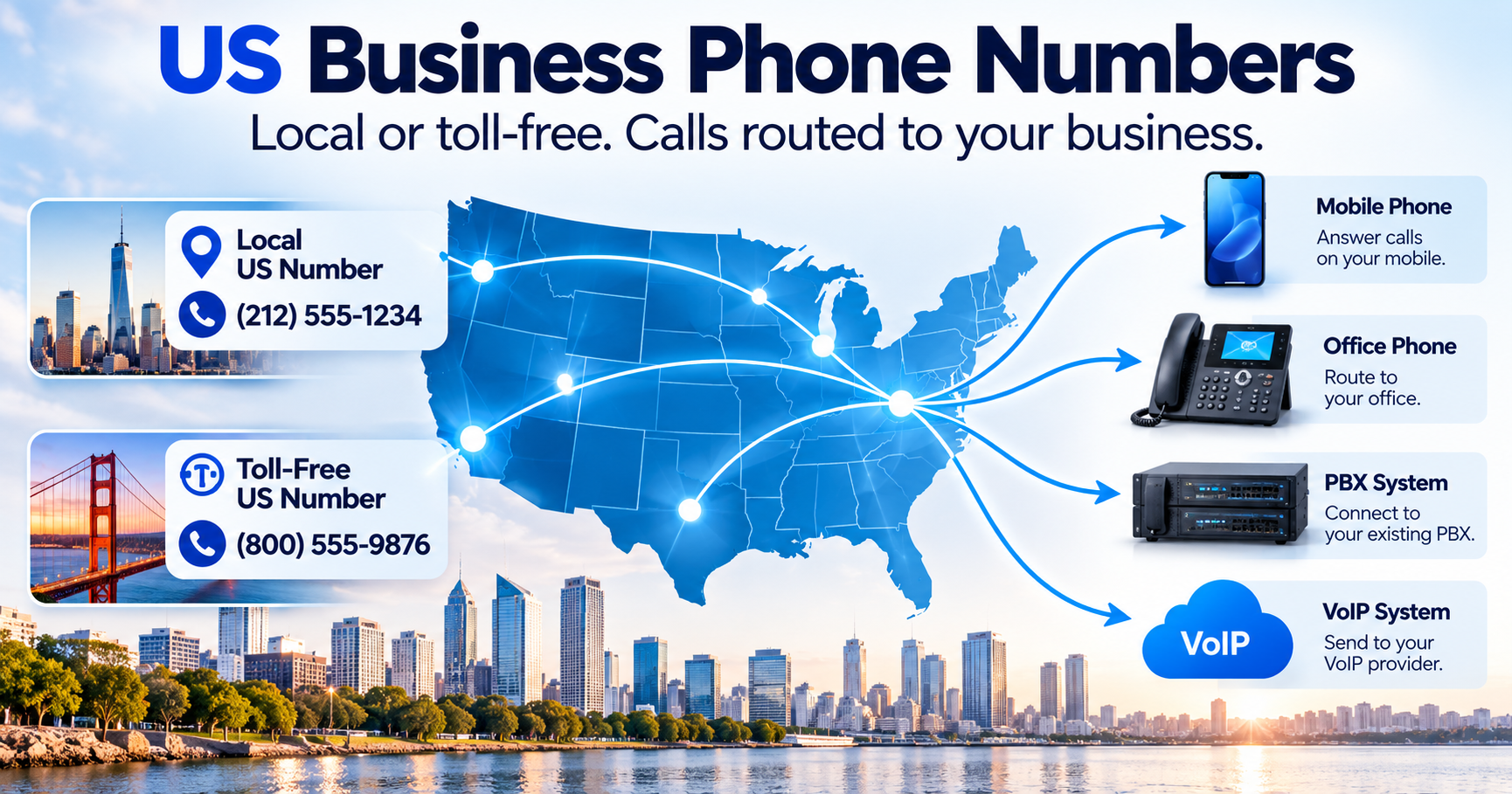
Choosing US business phone numbers involves more than deciding which digits to publish on your website. The type of number you select can influence how customers perceive your business, how they contact you, and how incoming calls are handled.
For businesses serving customers throughout the United States, two options are particularly relevant: local phone numbers and toll-free phone numbers.
A local number can provide a telephone identity associated with a particular geographic market. A toll-free number can provide a broader customer contact option without emphasizing one specific city.
Both can be useful for businesses that want to establish a dedicated telephone contact point while routing calls to an existing office, mobile phone, or supported business phone system.
AITelephone’s approved country-coverage database lists both Local and Toll-Free numbers for the United States. These are the two US number categories confirmed in that database. AITelephone_02_Country_Coverage…
This guide explains how the options differ, how virtual business numbers work, and what to consider before selecting a number for your company.
What Types of US Business Phone Numbers Does AITelephone Offer?
AITelephone’s approved coverage data confirms two US number categories:
- Local numbers: Associated with a geographic area or city.
- Toll-free numbers: Designed to provide callers with a toll-free calling option, subject to applicable calling and carrier rules. AITelephone_02_Country_Coverage…
The distinction matters because a number type available in one country should not automatically be assumed available in another. Likewise, availability of a number category does not guarantee that a particular number is currently in inventory.
For a US business, the first decision is whether a geographic telephone identity or a toll-free contact option better suits the intended audience.
1. US Local Business Phone Numbers
A local business number is associated with a geographic area, such as a city or region.
Businesses often use local numbers when they want a telephone contact that relates to the market they serve.
For example, a company targeting customers in a particular US city might prefer a local number associated with that area rather than presenting only a general corporate contact number.
When does a local number make sense?
A local number may be appropriate when:
- Your business serves customers in a particular city or geographic market.
- You want a market-specific telephone contact for advertising.
- You want a dedicated number for a particular sales or service operation.
- You want to distinguish a local customer contact from your main corporate number.
A local number does not, by itself, establish that a company has a physical office in the area. The number and the destination where calls are answered can be separate.
AITelephone’s US call-forwarding information describes local city numbers that can forward incoming calls to a designated phone destination. AITelephone
Important: Check the current inventory for the specific geographic area you need. The general availability of US local numbers does not guarantee the availability of every area code or number.
2. US Toll-Free Business Phone Numbers
A toll-free number provides another way for customers to contact a business.
Unlike a geographic local number, a toll-free number is not primarily intended to associate the business with a particular city.
Businesses may consider toll-free numbers when they serve customers across a broader geographic area.
When does a toll-free number make sense?
A toll-free number may be appropriate when:
- Your business serves customers throughout the United States.
- You want one telephone contact for a national sales or marketing campaign.
- You want a dedicated customer-service number.
- You prefer a telephone contact that does not emphasize one city.
Toll-free calling is subject to the applicable number, network, and carrier arrangements. Before publishing a number, confirm that it can be reached by the callers you intend to serve.
AITelephone’s approved coverage data lists US toll-free numbers as an available category. AITelephone_02_Country_Coverage…
Local vs. Toll-Free: How Should You Choose?
The choice depends on the role the number will play in your business.
| Consideration | Local Number | Toll-Free Number |
|---|---|---|
| Geographic identity | Associated with a local area or city | Not primarily associated with one city |
| Typical business use | Local sales, regional marketing, market-specific contact | National sales, customer service, broader marketing |
| Customer audience | A particular geographic market or other intended callers | A broader audience within the supported calling scope |
| Call destination | Can be routed to a designated phone destination | Can be routed to a designated phone destination |
| Physical office implied? | No; the number alone does not establish a physical office | No; the number alone does not establish a physical office |
| AITelephone US availability | Listed in approved coverage data | Listed in approved coverage data |
The table describes the general purposes of these number types. It does not guarantee the availability of a particular number or every possible configuration.
A practical example
Consider a company that sells products throughout the United States but also runs a marketing campaign targeting customers in one metropolitan area.
The company might investigate a local number for the geographic campaign and a toll-free number for its broader customer contact strategy.
Whether it needs one number or both depends on its marketing, staffing, and call-handling requirements.
The important step is to define the purpose of each number before ordering.
How Do Virtual US Business Phone Numbers Work?
A virtual business number separates the public telephone number from the physical destination where an incoming call is answered.
The basic process is straightforward:
- Choose the number. Select an available local or toll-free number appropriate for your business.
- Choose the destination. Determine where incoming calls should go.
- Configure call handling. Set up the supported routing and phone features you need.
- Publish the number. Add it to your website, advertising, email signature, or other business materials.
AITelephone supports forwarding incoming calls to mobile phones, landlines, PBX systems, and VoIP destinations. The destination can be located in a different country from the virtual number. AITelephone
This means a business can use a US number as a customer-facing contact while answering calls through an existing communications setup.
Example: A US number answered overseas
A company serving American customers might have its sales team working outside the United States.
Its call flow could look like this:
US customer → US virtual business number → designated international destination
The customer dials the US number, while the business routes the incoming call to its chosen destination.
This arrangement can be useful for businesses with international offices, remote employees, or centralized sales and support teams.
Can a US Business Number Ring Your Existing Phone?
Yes. AITelephone supports forwarding calls to existing mobile phones, landlines, PBX systems, and VoIP destinations. AITelephone
That can be useful if you already have a working telephone system and do not want to replace it simply to add another business number.
For example, you might route calls to:
- A company office phone
- A designated mobile phone
- An existing PBX
- A VoIP system
The appropriate destination depends on how your business handles calls and which configuration you select.
What Call-Handling Features Should You Consider?
The telephone number is only part of the decision. You should also consider how incoming calls will be managed.
AITelephone lists several call-management capabilities for its virtual-number services. Availability should be confirmed for the specific number and configuration.
Simultaneous Ringing
Simultaneous ringing allows incoming calls to ring multiple designated phones at the same time where supported. This can be useful when several employees share responsibility for answering calls. AITelephone
Time-of-Day Routing
Time-of-day routing allows calls to be directed according to a configured schedule and time zone.
A business might route calls to one destination during its normal operating hours and another destination outside those hours. AITelephone
Voicemail and Voicemail-to-Email
Voicemail provides an alternative when a call cannot be answered.
AITelephone lists voicemail and voicemail-to-email among its virtual-number features. These can help a business access messages without requiring the caller to reach an employee immediately. AITelephone
Online Call Management
AITelephone provides an online account portal for managing supported settings. Its current product information states that customers can change their forwarding destination through the portal, with changes taking effect in real time. AITelephone
Before ordering, identify the features you actually need and verify that they are available for your selected number and service configuration.
Can You Use a US Number for Outbound Calls?
Receiving calls and making outgoing calls are separate requirements.
If your employees need to make outbound calls while presenting a particular business number as caller ID, do not assume that this capability is automatically included with every local or toll-free number.
AITelephone describes outbound calling options for supported configurations, but the approved US coverage data confirms the Local and Toll-Free number categories without listing a separate US Local 2-Way Voice category. AITelephone
If outbound caller ID is essential to your operation, verify the specific capability with AITelephone before ordering.
How Much Does a US Business Phone Number Cost?
There is no single price that applies to every number and call destination.
AITelephone states that global call-forwarding pricing depends on the country or city of the selected virtual number and the destination where incoming calls are forwarded. The current rate interface provides pricing options for the selected requirements. AITelephone
Before comparing costs, determine:
- Whether you need a local or toll-free number.
- Where calls will be forwarded.
- Which service configuration meets your needs.
- Which current rate plan applies to that combination.
Avoid relying on an advertised price for a different destination or number type. Check the current rates for your intended setup.
View current rates and availability:
AITelephone Global Call Forwarding
What Should You Check Before Ordering?
Use this checklist to narrow down the right US business number.
1. Define your audience. Are you primarily serving customers in one geographic market or across a broader area?
2. Choose the number type. Decide whether a local or toll-free number better fits your intended use.
3. Confirm availability. Check the actual number inventory rather than assuming a particular area code or number is available.
4. Select the call destination. Decide whether calls should go to a mobile phone, landline, PBX, VoIP system, or another supported destination.
5. Identify routing requirements. Determine whether you need simultaneous ringing, time-of-day routing, voicemail, or other supported features.
6. Confirm outbound requirements. If employees need to make calls using the business number as caller ID, verify that the required functionality is available.
7. Check the current rates. Use the number and destination you actually intend to configure.
8. Verify any applicable requirements. The approved US coverage data confirms the availability of Local and Toll-Free numbers but does not list specific documentation requirements for either category. Do not assume that this means no requirements apply; confirm the current requirements during provisioning. AITelephone_02_Country_Coverage…
Choosing a US Business Phone Number for Your Company
A local number and a toll-free number can serve different purposes.
A local number can be appropriate when geographic identity matters to your business. A toll-free number can suit a broader customer contact strategy.
Both can be considered as part of a call-forwarding setup that routes incoming calls to a designated destination.
The best starting point is to identify your customers, decide how you want them to contact you, and determine where calls should be answered.
AITelephone’s approved US coverage data lists both local and toll-free virtual phone numbers. Its current global call-forwarding service supports forwarding to mobile phones, landlines, PBX systems, and VoIP destinations. AITelephone
Frequently Asked Questions
Does AITelephone offer US local business phone numbers?
Yes. The approved country-coverage database lists Local numbers as available in the United States. Availability of a particular number or area code must be checked separately. AITelephone_02_Country_Coverage…
Does AITelephone offer US toll-free numbers?
Yes. The approved coverage database lists Toll-Free numbers for the United States. Confirm current inventory and the intended callers’ ability to reach the number before ordering. AITelephone_02_Country_Coverage…
Can a US virtual number forward calls to another country?
AITelephone supports forwarding incoming calls to destinations worldwide, including mobile phones, landlines, PBX systems, and VoIP destinations. AITelephone
Can I use an existing business phone system?
Yes. AITelephone supports forwarding to existing mobile phones, landlines, PBX systems, and VoIP destinations. The exact configuration depends on your requirements. AITelephone
Can calls ring multiple phones?
Simultaneous ringing is supported for configurations where the feature is available. It allows an incoming call to ring multiple designated phones at the same time. AITelephone
Can I change where calls are forwarded?
AITelephone states that customers can change the forwarding destination through the online account portal, with changes taking effect in real time. AITelephone
How much does a US virtual business number cost?
Pricing depends on the selected number and forwarding destination. Check the current AITelephone rate interface for your specific requirements. AITelephone
Are all call-routing features available with every US number?
Do not assume that they are. Check the current service configuration and confirm the features you need before ordering.
Find the Right US Business Phone Number
Whether you need a local number for a geographic market or a toll-free number for a broader customer audience, start by checking the available options and deciding where incoming calls should be answered.
AITelephone offers US local and toll-free virtual phone numbers, with supported call forwarding to designated business phone destinations.
Explore current number availability and rates:
AITelephone Global Call Forwarding
You can also review the US-specific service information here: