

Have you ever wondered how your business phone system can ring across offices, cell phones, remote workers, and international branches — all without missing a single call? At the heart of this seamless communication is something called SIP call forwarding or SIP to PBX integration, and yes — you can forward your calls to your PBX via SIP!
In this article we’ll break down:
- What SIP call forwarding is
- Why companies absolutely need it
- SIP forwarding reduces phone system costs
- What happens when you forward your calls to a PBX (and why it’s smart)
- Examples of global companies using SIP call forwarding
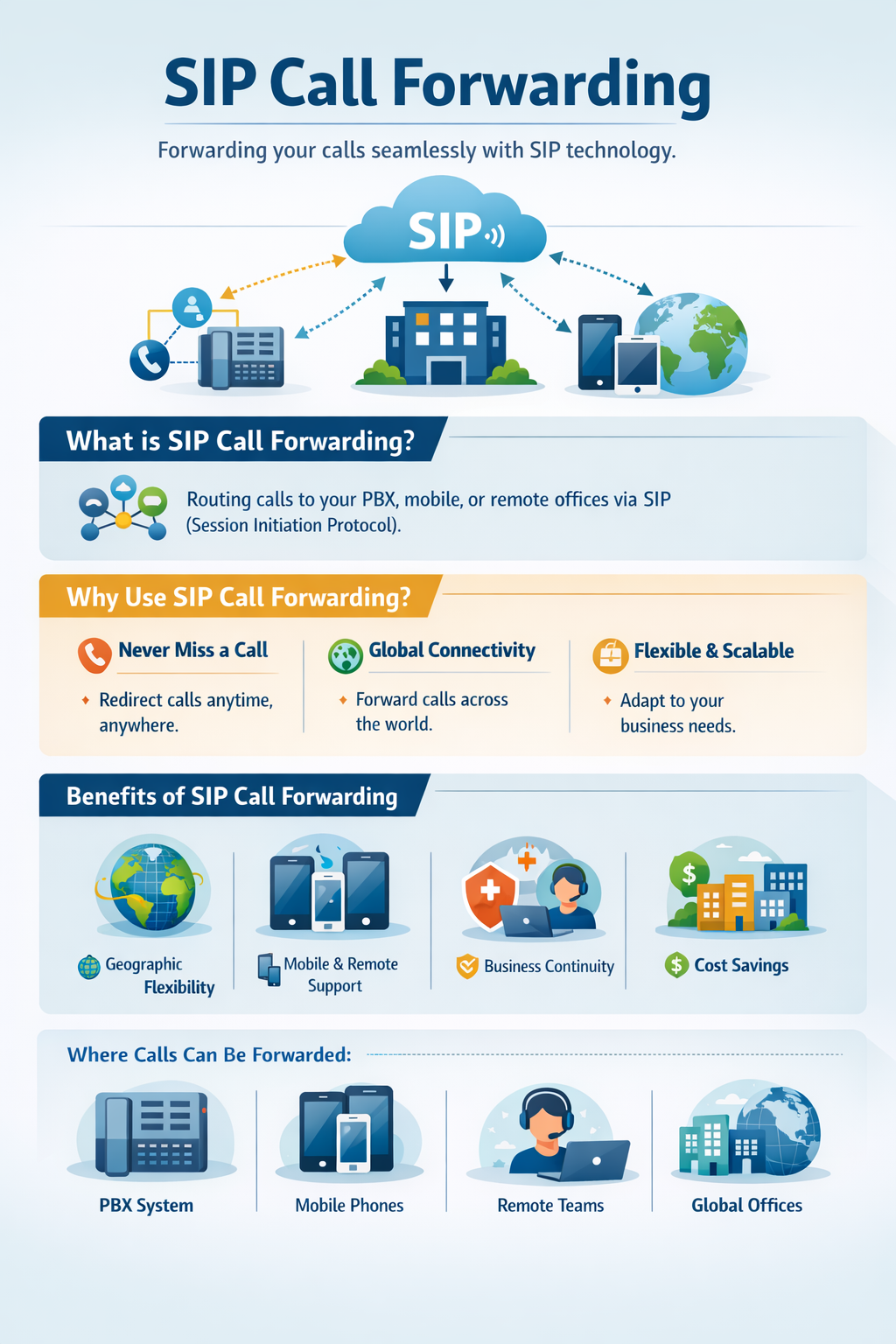
- A visual idea of what SIP call forwarding looks like
Let’s dive in!
🤔 What Is SIP Call Forwarding?
SIP (Session Initiation Protocol) is the technology that sets up, controls, and tears down voice or video calls over the internet — also known as VoIP.
SIP call forwarding to PBX is the feature that lets you automatically redirect incoming SIP calls to another endpoint, like:
📍 Your central PBX
📍 A mobile number
📍 A remote employee extension
📍 A different office location
📍 A call center
Think of it like routing traffic — but for phone calls.
This isn’t just a fancy feature. It’s a business necessity.
🚀 You Can Forward Your Calls to Your PBX via SIP with SIP trunk call forwarding
Absolutely!
One of the biggest advantages of modern SIP trunking and VoIP systems is the ability to seamlessly integrate call forwarding directly into your PBX. That means:
✔ All calls — even external ones — ride on your existing internet connection
✔ No need for traditional phone lines
✔ Easy scalability for remote and global teams
✔ Centralized management of routing rules
In short, SIP lets your communication infrastructure be as modern and flexible as your team needs it to be.
🧠 SIP routing rules for PBX systems and The Need for SIP Call Forwarding
Why does any business really need SIP call forwarding?
Here’s the truth:
👉 Customers want instant answers
👉 Teams are increasingly mobile
👉 Offices are distributed globally
👉 Work doesn’t stop after 5PM
Forwarding calls just to a static desk phone doesn’t cover it anymore.
Here are some of the core benefits:
🔄 1. Geographic Flexibility
Your sales team in London can receive calls originally directed to New York without a second phone line.
📱 2. Mobile & Remote Worker Support
Forward incoming SIP calls directly to a staff member’s mobile phone or softphone app — no VPN required.
📈 3. Business Continuity & Redundancy
If your primary office goes offline (internet outage, power outage, natural disaster), calls can instantly redirect to a backup PBX.
📊 4. Improved Customer Experience
No more voicemail loops or dropped calls — unanswered calls are forwarded based on your rules.
💸 5. Operational Cost Savings
Instead of maintaining expensive traditional PBX lines, your calls are routed via SIP trunks over your internet bandwidth — often drastically reducing cost.
🔁 How SIP Call Forwarding Works in Practice
When an incoming call arrives:
- The VoIP provider receives the SIP INVITE for the call.
- Intelligent routing rules check where the call should go — based on time of day, availability, geography, etc.
- The call is forwarded to a designated SIP endpoint — like your PBX or a different destination.
- The call connects.
And — just like that — your caller gets connected, regardless of where your team physically is.
This level of flexibility is especially important for global companies that operate across time zones and regions.
🌍 Global Companies That Use SIP Call Forwarding
Many major enterprises and brands leverage SIP call forwarding as a critical piece of their communications strategy. While specific internal phone system architectures are proprietary, these companies are known for modern, cloud-ready voice infrastructures — and SIP routing is a core part of that.
Here’s a non-exhaustive list of global organizations that rely on SIP call forwarding or similar SIP-based call routing:
📌 Major Global Brands Using SIP Call Forwarding
📍 Microsoft – For Office 365, Teams Business Voice, and global enterprise routing
📍 Google – For Google Voice and SIP integrations across G Suite
📍 Amazon – For AWS VoIP deployments and contact center routing
📍 IBM – SIP voice consolidation across business units
📍 Cisco – SIP call routing on CallManager & Webex platforms
📍 AT&T – SIP trunking + call forwarding solutions for enterprise clients
📍 Verizon – Business voice SIP solutions
📍 Vodafone – SIP voice & roaming forwarding services
📍 Siemens – Global communications for industrial and enterprise clients
📍 BT (British Telecom) – SIP business voice services in EMEA
These brands may implement SIP call forwarding differently — but the common thread is scalable, flexible call routing across networks, time zones, and teams.
🤝 Integrating SIP Call Forwarding With Your PBX
If you already run a PBX — whether it’s on-premise or cloud — integrating SIP call forwarding can be straightforward:
👉 Provision your SIP trunks with your VoIP provider
👉 Define routing rules (time-based, priority-based, location-based)
👉 Connect your PBX to those SIP trunks
👉 Set forwarding rules for inbound numbers and extensions
Some PBX systems — like 3CX, FreePBX, Cisco UCM, or Microsoft Teams — support advanced SIP forwarding natively.
💡 Tips for Successful SIP Call Forwarding
Here are some practical tips when configuring call forwarding to your PBX:
🌐 ☁️ Use Redundant SIP Providers
If one SIP provider has an outage, another can take over call routing.
🕒 Configure Time-of-Day Routing
Forward calls differently after hours or on weekends.
🔐 Implement Secure SIP (TLS/SRTP)
Keep voice traffic encrypted and authenticated.
📱 Enable Softphone Forwarding
Integrate mobile and desktop SIP apps so your team can receive calls from anywhere.
✨ The Future of SIP Call Forwarding
SIP has been around for decades — but it continues evolving. Today, it:
✔ Powers cloud telephony
✔ Integrates with APIs (e.g., contact center automation, CRM triggers)
✔ Connects to messaging + video systems
✔ Supports redundancy and mobility at scale
Forwarding calls to your PBX via SIP isn’t just a convenience — in the digital age, it’s part of how modern business communication should work.
✅ SIP phone system integration
SIP call forwarding — including forwarding calls to your PBX via SIP — is no longer an optional feature. It’s a foundational part of modern business voice strategies. With global teams, remote workers, and customer expectations for instant connectivity, SIP gives you:
✨ Flexibility
✨ Cost savings
✨ Reliable routing
✨ Seamless call continuity
Whether you’re a small business or a multinational enterprise, understanding and implementing SIP call forwarding to PBX is a game-changer in how you communicate.
