Expanding into another country creates an immediate communications question:
How will customers in that market call your business?
A company can publish its existing international telephone number, but that may not provide the most convenient way for customers in another country to reach it.
A different approach is to establish a local business phone presence using a virtual phone number associated with the target market.
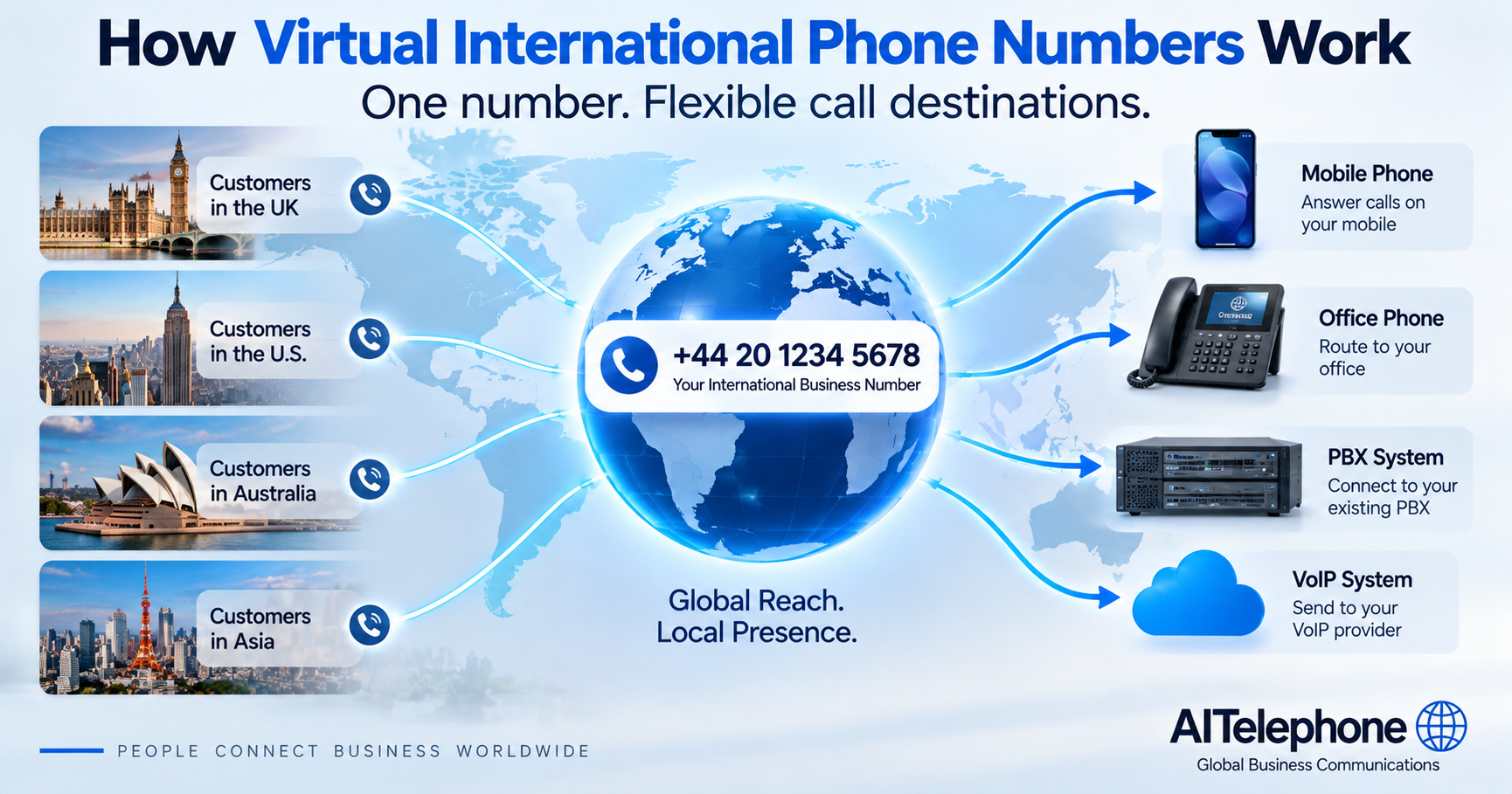
With a virtual number, the telephone number customers call can be associated with another country or city while incoming calls are routed to the business’s existing office, mobile phone, PBX, or VoIP system.
AITelephone currently offers local and toll-free virtual phone numbers in more than 160 countries, with specific number types and availability varying by country and location.
What Does a Local Business Phone Presence Mean?
A local phone presence means giving customers in a particular market a telephone number associated with that market.
The important distinction is that the number’s location and the business’s physical location do not necessarily have to be the same.
https://www.aitelephone.com/country-phone-number-finder.html
For example, a company headquartered in the United States could establish a virtual number for a market it serves overseas and route incoming calls back to its U.S. operation.
The basic arrangement looks like this:
International customer
↓
Local virtual business number
↓
Call routing
↓
Business office, mobile phone, PBX, or VoIP system
This allows the company to create a customer-facing telephone point of contact in another market without necessarily building a separate traditional telephone installation there.
Why Establish a Local Phone Presence?
There are several practical reasons a business might want a local number in another country.
Make It Easier for Customers to Call
A customer may be more comfortable calling a number associated with their own country or city than calling a company’s overseas headquarters directly.
A local number can therefore make the telephone contact process more straightforward.
Support International Sales with a local business phone presence
A company entering a new market may want prospective customers to have a dedicated number for sales inquiries.
That number can be published on the company’s website, advertising, email communications, business cards, and other marketing materials.
Support Customer Service
A dedicated market-specific number can also be used for customer support.
Calls can be routed to the existing support team rather than requiring the business to establish a separate support operation in every country.
Test a New Market
A business investigating international expansion may want to establish a telephone contact point before making larger investments in local infrastructure.
A virtual number can provide one component of that market-entry strategy.
How to Establish a Local Business Phone Presence
The process can be broken into several practical steps.
1. Identify the Market You Want to Serve
Start with the country or geographic market where you want customers to be able to reach your business.
Think about where your customers actually are rather than simply choosing a country because you intend to expand there someday.
For example, a company might be targeting:
- Customers in a particular country
- Customers in a specific city
- Customers throughout a national market
- International customers who need a toll-free contact option
The appropriate number type depends on the market and what is currently available.
2. Decide Whether You Need a Local or Toll-Free Number
A business generally needs to decide whether a local or toll-free number better fits its customer base.
Local Number
A local number can associate the business with a particular geographic market.
This can be useful when the business wants customers in a specific city or region to have a geographically relevant telephone number.
Toll-Free Number
A toll-free number can be appropriate when a business wants to provide a telephone contact option that is not centered on one particular city.
The availability and characteristics of toll-free numbers vary by country.
AITelephone currently provides both local and toll-free virtual numbers in more than 160 countries, subject to specific availability.
3. Check Current Availability
International telephone numbering is not uniform.
A number type that is available in one country may not be available in another.
Likewise, specific cities, number ranges, features, and requirements can differ.
Before promoting a number in a particular market, verify:
- Country availability
- Number type
- Geographic availability
- Current pricing
- Any applicable documentation requirements
- Available calling features
- Forwarding destination options
This step is important because a general statement about international coverage should never be treated as a guarantee that a particular number is available for every business requirement.
4. Choose Where Incoming Calls Will Be Answered
Once the business has identified an appropriate number, determine where incoming calls should go.
AITelephone supports forwarding to destinations including:
- Mobile phones
- Landlines
- PBX systems
- VoIP destinations
The destination can be located in a different country from the virtual number.
For example:
Customers in Germany → German virtual number → U.S. sales team
The sales team does not necessarily have to be physically located in Germany to answer calls made to the German number.
5. Configure Call Handling
A local number is more useful when the business can determine how incoming calls are handled.
AITelephone provides call-routing features that can include:
- Simultaneous ringing
- Time-of-day routing
- Extension routing
- Voicemail
- Voicemail-to-email
- Other call-handling options
These features can be managed through the online account portal.
The appropriate configuration depends on how the company operates.
A small business might simply forward calls to one mobile phone.
A larger organization might route calls to an office phone system or PBX.
6. Publish the Number
Once the number and call routing are configured, make the number visible to the customers you want to reach.
Possible locations include:
- Website contact pages
- Country-specific landing pages
- Email signatures
- Business cards
- Sales presentations
- Advertising
- Product literature
- Customer support materials
Consistency matters.
If a business establishes a local number for a market, customers should be able to find that number easily.
You Do Not Necessarily Need a Local Office
One of the important characteristics of virtual international numbers is that the business does not necessarily have to establish a physical office in the same country.
AITelephone states that in many countries a physical office is not required to obtain a virtual phone number. However, country-specific requirements and number availability can vary by country and number type.
This distinction is important.
A virtual phone number can provide a telephone presence in a market.
It does not by itself establish a legal entity, office, warehouse, employee base, or other physical business operation in that country.
Businesses should therefore treat the telephone number as one component of an international expansion strategy, not as a substitute for any legal or operational requirements that may apply to the business.
Where Does the Business Actually Answer the Call?
This is one of the most useful aspects of a virtual number.
The business can separate the public telephone number from the location where employees answer calls.
For example:
Option 1: Mobile
Local number → employee mobile phone
Option 2: Office
Local number → company landline
Option 3: PBX
Local number → existing business PBX
Option 4: VoIP
Local number → VoIP system
AITelephone supports these types of forwarding destinations.
That flexibility can be particularly useful for businesses with remote employees or centralized international sales and support teams.
Can Multiple Employees Answer the Same Number?
Yes, where the applicable service configuration supports simultaneous ringing.
AITelephone states that simultaneous ringing allows an incoming call to ring multiple phones at the same time.
For example, a company’s international number could potentially ring several designated phones so that the first available employee can answer.
This can be useful when a business does not have a dedicated employee assigned exclusively to the target market.
What About Customers Calling Outside Business Hours?
International businesses may have customers calling from several time zones.
Time-of-day routing can help address this.
AITelephone supports time-of-day routing with time-zone settings, allowing calls to be directed according to a configured schedule.
For example:
Business hours → Main office
After hours → Alternate destination
A business serving multiple markets can use appropriate routing configurations to coordinate its available staff and operating hours.
Can the Same Number Be Used for Outbound Calls?
Sometimes.
Businesses that only need to receive calls have a different requirement from businesses that need to make outgoing calls using the same telephone identity.
AITelephone offers a Geographic Local 2-Way Voice option in supported countries. This can allow outbound calls using the virtual number as caller ID.
AITelephone currently describes this option as available in approximately 70 countries, so it should not be assumed to be available with every international number.
If outbound calling is important, verify that the specific country and number support the required functionality before selecting the service.
A Local Business Phone Presence Does Not Have to Mean a Separate Phone System
A common misconception is that obtaining a telephone number in another country means installing a complete telephone system there.
A virtual number can work differently.
The public number can be in the target market while the underlying call-handling operation remains centralized.
For example:
France number → U.S. sales team
Australia number → U.S. support team
United Kingdom number → European office
The exact arrangement depends on the company’s needs and the available number and routing configuration.
The important point is that the number can serve as the local-facing entry point while the business maintains flexibility over where calls are handled.
Building a Local Phone Presence for Multiple Countries
Businesses expanding into several markets may need more than one international number.
A company could potentially maintain different numbers for different countries while managing call destinations centrally.
For example:
| Market | Public Number | Possible Call Destination |
|---|---|---|
| United Kingdom | UK virtual number | U.S. sales team |
| Australia | Australian virtual number | U.S. support team |
| Germany | German virtual number | European office |
| Canada | Canadian virtual number | North American support |
The specific availability of each number would need to be verified before implementation.
The advantage of this model is that the business can create market-specific contact points without necessarily creating an entirely separate telephone infrastructure for every market.
What Should You Consider Before Choosing a Number?
Before establishing a local business phone presence, ask the following questions.
Where Are Your Customers?
Choose the market based on where customers actually need to reach you.
Do You Need a City-Specific Number?
If your business is targeting a particular city, a local geographic number may be more appropriate.
Do You Want Broader National Coverage?
A toll-free or other national option may make more sense depending on what is available in the target country.
Where Will Calls Be Answered?
Determine whether calls should go to a mobile phone, office, PBX, or VoIP system.
Do You Need Multiple Employees to Answer?
If so, investigate simultaneous ringing and other routing options.
Do You Need After-Hours Routing?
If customers are in different time zones, consider time-of-day routing.
Do You Need Outbound Calling?
If employees need to call customers while displaying the local number, verify whether Local 2-Way Voice is available for that specific market.
Are There Country-Specific Requirements?
Always check current availability and requirements for the particular country and number type.
Using a Local Number as Part of an International Expansion Strategy
A telephone number is only one piece of an international business strategy.
A company entering a new country may also need to address:
- Website content
- Customer support
- Local business hours
- Sales coverage
- Language
- Shipping
- Payments
- Tax requirements
- Legal requirements
- Local marketing
The phone number addresses one specific question:
How can customers in this market reach us?
That makes it a relatively focused component of a broader international expansion plan.
When a Virtual Local Number Makes Sense
A virtual local number can be particularly useful when:
- Your business serves customers in another country.
- You want a market-specific telephone contact.
- Your employees already work from another location.
- You want calls routed to an existing phone system.
- You are testing demand in a new market.
- You need different telephone numbers for multiple countries.
- You want to centralize call handling rather than build separate telephone systems.
The right configuration depends on the business and the target market.
Establish Your International Phone Presence
Creating a local business phone presence in another country does not necessarily require opening a physical office there.
A virtual number can provide a market-specific telephone contact while allowing incoming calls to be routed to the business’s existing mobile phone, landline, PBX, or VoIP system.
AITelephone currently offers local and toll-free virtual numbers in more than 160 countries, with specific availability and number types varying by country and location.
Check AITelephone international number availability and rates
Frequently Asked Questions
How can I establish a local phone presence in another country?
A common approach is to obtain a virtual local or toll-free number associated with the target country and route incoming calls to an existing business phone, mobile phone, PBX, or VoIP system.
Do I need a physical office in the country?
Not necessarily. AITelephone states that in many countries a physical office is not required, although requirements vary by country and number type.
Can the number ring my existing mobile phone?
Yes. AITelephone supports forwarding incoming calls to mobile phones, as well as landlines, PBX systems, and VoIP destinations.
Can I use a virtual number for customer support?
Yes. A virtual number can be configured to route calls to an appropriate support destination, subject to the features available for the selected number.
Can multiple phones ring when someone calls?
Yes. Simultaneous ringing is supported where available.
Can calls be routed according to business hours?
Yes. AITelephone supports time-of-day routing with time-zone settings.
Can I use the local number when making outbound calls?
In supported countries, AITelephone’s Geographic Local 2-Way Voice option can allow the virtual number to be used as caller ID for outbound calls. Availability is country-specific.
How many countries does AITelephone cover?
AITelephone currently states that local and toll-free virtual phone numbers are available in more than 160 countries. Specific number types and availability vary by country and location.